
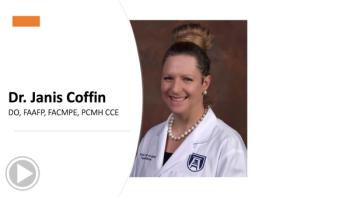
Dr. Janis Coffin, DO, discusses how telehealth has increased the opportunity to manage patients with chronic conditions and how practices can financially benefit from these setups.
Dr. Janis Coffin, DO, discusses how telehealth has increased the opportunity to manage patients with chronic conditions and how practices can financially benefit from these setups.
Dr. Janis Coffin, DO, discusses how she has witnessed telehealth adoption change over the course of the pandemic

How reputation management has been key to attracting more customers for one virtual care program.
How one practice managed the transition to virtual care before the pandemic.

Some of the ways the industry is addressing these issues in medical school and beyond.
Patients can hold biases toward physicians in the same way that physicians can be biased in their care delivery.
The difference between a ‘conscious bias’ and an ‘unconscious bias’ and how they are measured.
What bias means for physician’s everyday work experiences.

What practices should be planning for to make the best RCM strategy this year, from David Cohen, chief product and technology officer of Greenway Health.
How billing for telehealth services have changed throughout the pandemic.
The benefits and challenges involved with integrating a telehealth system with an EHR.
The concept of integrated telehealth solutions and how this impacts workflows.

Physicians Practice® spoke with Colin Carr, CEO of Carr Realty, to find out what physicians and practice owners should know about real estate trends in early 2021 and the best practices in making commercial healthcare real estate purchases.

How physicians can remain updated with standards of care.
Will point solutions continue to emerge, or will there be a widespread consolidation of programs and services?
How providers should take issues into consideration when exploring point solutions for their patients.
The phenomenon of ‘point solution fatigue’ affecting physicians, providers, and payers.

Physicians Practice® spoke with Krisi Hutson, the product line director at Availity, to discuss some of the ways in which she has been seeing providers help their patients to avoid surprise billing scenarios.
The shortcomings of current standards of care and why finding solutions might be so challenging and complex.
What we mean by ‘standards of care’ are, as well as how they are developed.

Advice for medical student hopefuls.
What's in store for the future of healthcare.
A student reflects upon his experiences.
The program’s setup and what it would look like in a traditional, non-pandemic world.

The benefits to simplifying technology at your practice.
The solutions to contemporary EHR and interoperability challenges.
The state of interoperability in healthcare today and how this is impacting physicians.
What EHR and EMR systems should look like in order to provide the best experience for physicians.
EHR and EMR systems are developed without considering how a physician thinks and works.
Introductory clip from the discussion on Medical World News.