
Practice Academy: Practice Management Track - Register Now
Blog|Articles|October 9, 2026

Upsetting the remote patient monitoring apple cart: Balancing program integrity and patient access

Fact checked by: Keith A. Reynolds

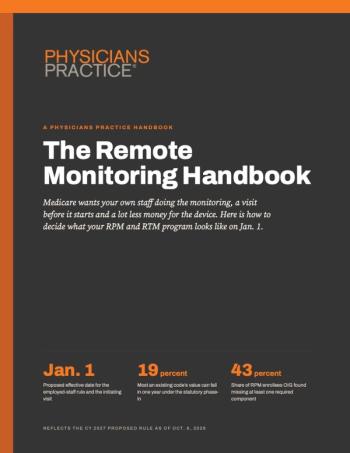
CMS' 2027 fee schedule proposal would pay for RPM and RTM only when practice employees do the work. Here's what practices should review now.

On July 16, 2026, the Centers for Medicare & Medicaid Services (CMS) published the CY 2027 Medicare Physician Fee Schedule Proposed Rule (2027 Proposed PFS), 91 Fed. Reg. 43842 (July 16, 2026). The proposed rule, CMS-1848-P, includes significant changes to remote physiologic monitoring (RPM) and remote therapeutic monitoring (RTM), including proposals affecting patient eligibility, initiating visits, staffing, payment and coding. The public comment period closed Sept. 14, 2026.

For physician practices, the most consequential proposal may be CMS' plan to permit payment for RPM and RTM only when the services are furnished by clinical staff employed by the billing practice, rather than contractors. If finalized, the change could affect vendor relationships, staffing models, documentation, billing controls and the viability of existing monitoring programs.

RPM, RTM and CCM: The coding baseline

RPM generally involves the collection and transmission of physiologic data, such as blood pressure, weight, glucose or pulse oximetry, from a connected medical device for use in managing a patient's condition. CMS explains that RPM allows patients to collect their own health data and automatically transmit it to their health care provider. CMS identifies three principal components: education and setup, device supply, and treatment and management. See CMS, Remote Patient Monitoring.

RTM addresses therapeutic or nonphysiologic data, including information related to respiratory status, musculoskeletal conditions, medication adherence, pain or treatment response.

CCM is designed for patients with two or more chronic conditions expected to last at least 12 months, or until death, that place the patient at significant risk of death, acute exacerbation or decompensation, or functional decline. CMS describes CCM as a critical primary care service that contributes to better patient health and care. See CMS, Chronic Care Management.

These distinctions matter because the services have different eligibility, device, transmission, time and documentation requirements. Enrollment, data collection or vendor activity alone does not establish that a particular Medicare service was furnished or that all billing requirements were met.

What CMS is proposing

CMS proposes several changes to RPM and RTM for CY 2027. Specifically, CMS would:

  • Limit RTM services to established patients.
  • Require practitioners reporting RPM or RTM to furnish a separately reportable initiating visit in connection with the onset of services.
  • Allow payment for RPM and RTM only when the clinical staff furnishing the services are employed by the practice, rather than supplied by contractors.
  • Update the valuation of remote monitoring services based in part on CMS' assessment that device costs may be lower than previously estimated.
  • Seek comment on bundling the existing RPM and RTM CPT codes into four new HCPCS G-codes.

In its CY 2027 PFS Fact Sheet, CMS states that the proposed G-code approach would respond to recommendations in recent Office of Inspector General reports that CMS does not believe can be fully resolved through the current remote-monitoring code structure. CMS also expressly highlights the proposal to disallow payment when services are delivered by contractors rather than clinical staff employed by the practice.

Collectively, these proposed changes extend well beyond a routine coding update. If finalized, practices may need to reevaluate staffing models, vendor relationships, patient onboarding processes, documentation practices, charge capture workflows, coding oversight and overall program sustainability.

The coding structure has already changed

The 2027 proposal comes against a changing RPM and RTM coding landscape. Beginning Jan. 1, 2026, Medicare adopted additional shorter-duration codes, creating separate thresholds for monitoring days and treatment-management time.

  • RPM device supply: CPT® 99445 addresses 2-15 days of data in a 30-day period, while CPT® 99454 applies when the applicable 16-day threshold is met.
  • RPM treatment management: CPT® 99470 addresses 10-19 minutes in a calendar month; CPT® 99457 addresses the first 20 minutes, with CPT® 99458 for each additional 20 minutes.
  • RTM device supply: CPT® 98984, 98985 and 98986 address 2-15 days for the applicable monitoring category, while CPT® 98976, 98977 and 98978 address the corresponding longer-duration services.
  • RTM treatment management: CPT® 98979 addresses 10-19 minutes; CPT® 98980 addresses the first 20 minutes, with CPT® 98981 for each additional 20 minutes.

Practice and operational considerations

  • Staffing and operations. Small, rural and specialty practices that rely on outsourced monitoring services may need to evaluate staffing, technology and operational workflows if certain functions must be performed by practice-employed clinical staff.
  • Employment status. The proposal raises questions regarding what CMS means by “employed by the practice” for Medicare payment purposes and whether the requirement would be limited to traditional W-2 employees or extend to other affiliated arrangements.
  • Initiating visits and documentation. A separately reportable initiating visit may place greater emphasis on documenting the clinical rationale for monitoring, the condition being monitored, treatment goals, relevant devices or data and patient consent, as applicable.

Program integrity and compliance

CMS' concerns about remote-monitoring billing reflect broader program-integrity considerations. The government's concerns are not unwarranted, but they are not necessarily specific to whether clinical staff are employees or contractors. Similar compliance issues may arise when services are not medically necessary, not fully performed or not adequately supported by documentation.

Areas of consideration include:

  • Enrolling patients without documented medical necessity.
  • Billing unsupported time or data thresholds.
  • Billing services or components not actually furnished.
  • Using noncompliant devices or transmission methods.
  • Counting unsupported, duplicated or noncountable time.
  • Billing for passive review or unsuccessful communications when qualifying interaction is required.
  • Continuing charges solely because a patient remains enrolled.
  • Duplicating services across RPM, RTM, CCM or other care-management programs.
  • Relying on templated documentation that does not demonstrate patient-specific monitoring or clinical action.

The False Claims Act also provides an important backdrop. In United States ex rel. Family Clinic of Albany v. ChartSpan Medical Technologies, No. 3:21-cv-139 (N.D. Miss.), the relator alleged, among other things, kickbacks and failure to provide the type and level of care necessary to support certain billed codes. On July 27, 2026, the court entered an order dismissing the action after being advised by counsel that the matter “has been resolved or is in the process of being resolved.” Dkt. 114.

The case illustrates why remote-monitoring arrangements can raise issues extending beyond ordinary coding errors. Depending on the facts, unsupported billing, improper financial arrangements or services that do not meet applicable requirements may create exposure under federal fraud-and-abuse laws.

At the same time, an internal employee can perform an unsupported service just as a contractor can. The central compliance question is whether the service meets applicable Medicare requirements and is actually furnished, documented and billed as claimed. Changing the worker's employment label, by itself, does not establish medical necessity, performance, documentation or billing accuracy.

What practices can do now

In anticipation of the final rule, practices may consider the following:

  • Review workflows and responsibilities related to patient enrollment, monitoring activities, documentation, coding, billing and vendor involvement.
  • Evaluate compliance with current requirements, including medical necessity, device, transmission, time, communication, supervision and documentation standards.
  • Assess billing controls to identify unsupported thresholds, duplicate services or recurring charges that may lack adequate support.
  • Reconcile claims to source documentation, including transmission logs, communication records, time tracking and the medical record.
  • Conduct periodic reviews of documentation, coding and billing practices to identify and address potential gaps or inconsistencies.
  • Review vendor and financial arrangements to ensure they align with applicable regulatory and compliance requirements.
  • Monitor future CMS guidance and evaluate any operational changes considering the final CY 2027 PFS rule.

Conclusion

The 2027 Proposed PFS presents an opportunity for CMS to address program integrity concerns related to remote monitoring services. While the proposed changes are intended to strengthen oversight, questions remain regarding how certain provisions, including the proposed employment requirement, may affect existing care delivery models. As the rulemaking process continues, practices should evaluate current RPM and RTM programs, monitor CMS guidance and prepare for potential operational and compliance adjustments following publication of the final rule.

Author note: This article discusses a proposed rule and is intended for educational purposes only. Practices should review the final rule, current CPT® and HCPCS code descriptors, applicable Medicare requirements and payer-specific guidance before changing operations, staffing, contracting or billing practices.


Rachel V. Rose, J.D., MBA, advises clients on compliance, transactions, government administrative actions and litigation involving health care, cybersecurity, corporate and securities law, as well as False Claims Act and Dodd-Frank whistleblower cases. She also teaches bioethics at Baylor College of Medicine in Houston. Rose can be reached through her website, www.rvrose.com.

Pam D'Apuzzo, CPC, CPMA, is a managing director at VMG Health within the Revenue Optimization Consulting Practice.


Related to this article