
From payer contract homework to a 15-minute morning huddle, these are the moves practice administrators can make after four days of sessions and interviews at MGMA's centennial meeting.
Try cheap solutions now because your most reliable employee may be ready to walk.
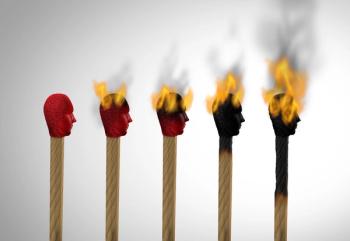
Clinician burnout is a predictable result of how work is designed, not a failure of individual grit, said an author who warns that the most reliable workers may be the ones most likely to leave.
Terra Bruns, DBA, offered anecdotal examples and low-cost solutions in "The Biology of Burnout: Why 'Self-Care' Can't Fix a Structural Problem," her presentation at the Medical Group Management Association (MGMA) 2026 Annual Conference. She is the author of "The Buffer Effect: How to Escape the Hero Trap and Become a Systemic Leader."
Workplace structures and decisions may be well-intentioned but not helpful to the clinicians caring for patients, Bruns said.
One example: With low morale and tight staffing, ICU nurses were at their breaking point. Administrators built them
The room was in the hospital basement. The ICU was on the fourth floor, and the nurses had no time to get there.
"It becomes a monument to the disconnect within the organization," Bruns said.
"Friction tax" is cost paid by staff that eventually shows up as lost margin, Bruns said.
Bruns described a boardroom decision to switch to cheaper sterilization caps. The savings came to 2 cents per cap, or $250,000 a year, based on volume. But nurses who had been able to apply the old caps with one hand, leaving the other free to comfort a patient, now needed two hands and sometimes had to start over. "That's something a nurse does 40 times a shift," she said.
That strain never reached the executives who made the decision, she said. Instead, nurses quietly disengaged and updated their resumes.
"It saved them $250,000, but when Nurse Jenny and three or four other nurses walk out the door, that $250,000 is long gone because we now have to replace them, train new nurses, and get them back up to speed," Bruns said.
The same thing happens outside nursing, she said.
"If you work in discharge and you have to take information from one software program and put it in three different places to get the patient discharged, that is structural friction," Bruns said.
Along with workplace friction, health care organizations have examples of the "hero" employees working hard to make things work. Bruns' presentation stated: "Heroism is a lagging indicator of a broken system."
"Nurse Jenny" is Bruns' name for the employee every leader wants: the one who sits on hold with the electronic health record vendor or runs up two flights of stairs when a medication dispensing machine fails. Bruns said those heroics are
"The problem is she has limits. She is a human being," she said. "She has physiological limits."
When Nurse Jenny leaves, the problems she absorbed land on everyone else.
Bruns offered tools she said cost nothing and need no executive approval.
"ASAP should be removed from your vocabulary," she said.
The subject line should state the outcome, such as patient safety or team building, she said.
"By giving people all of that context wrapped around what it is you want them to do, they're more available mentally to do what it is that you ask them to do," Bruns said.
Supervisors who have lost touch with daily work, including executives, spend two to three hours working alongside staff to find where software, workflows or supplies slow them down. Bruns said the audit should identify the specific stressor, what it costs staff in time and strain, and what leadership can concretely remove.
She said the audit, when done, "will, number one, change lives. Number two, it will change your organization. And number three, it will build cohesion within your team."
In a live poll, only 12% of attendees said their organization's main response to burnout was structural workflow changes. The most common answer, at 44%, was pizza parties, and 24% said staff are simply asked to push through.
Fixing friction doesn't require a new budget line, she said, only the willingness to see the work as staff experience it.
"And that doesn't cost any money. Doesn't take any approval from any group, from any admin," Bruns said. "It just takes the foresight of seeing you are dealing with human beings."