
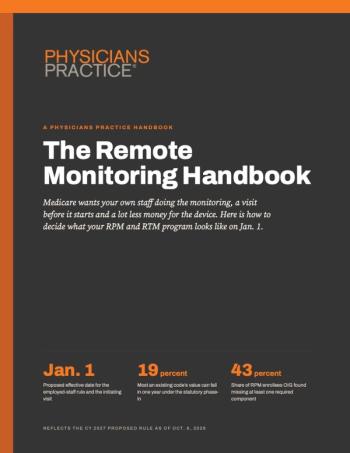
A 2027 Medicare proposal would stop paying for RPM time logged by vendor staff and cut device payments. Our handbook walks through what to do.
Medicare would pay for RPM and RTM only when practice-employed clinical staff do the work under the CY 2027 fee schedule proposal.
Medical practices that hand their remote monitoring programs to an outside vendor would lose Medicare payment for that work starting January 1, 2027.
That is one of the sharpest turns in the Calendar Year 2027 Medicare Physician Fee Schedule proposed rule, issued July 14. Medicare would pay for remote physiologic monitoring and remote therapeutic monitoring only when the services are performed by clinical staff employed by the billing practice, and not when they are delivered by contractors,
Two more guardrails come with the employment requirement. Practices reporting RPM or RTM would have to furnish a separately reportable initiating visit tied to the onset of monitoring, and RTM services could be billed only for established patients. CMS also proposes to revalue the codes downward, saying the devices appear to be available at a lower cost than the agency assumed when it first priced the services.
The agency is weighing a bigger rewrite as well. In a comment solicitation, CMS raises the possibility of bundling the RPM and RTM CPT codes and creating four new HCPCS G codes to describe remote monitoring, an approach it says would address recommendations from recent HHS Office of Inspector General reports that cannot be fully resolved within the current coding structure.
Kyle Zebley, CEO of the American Telemedicine Association and executive director of ATA Action, said in the group's
Remote monitoring is not the only technology thread. ATA Action's summary counts five codes added to the Medicare telehealth list, two new telehealth modifiers, and a new payment category called Software as a Medical Service covering algorithm-based clinical decision support with clinical or diagnostic functionality. CMS also issued a request for information on duplicate laboratory testing and imaging, noting that results are frequently siloed inside the acquiring EHR, leaving treating physicians unaware that the tests exist and ordering them again.
The Quality Payment Program section is where the technology proposals get most concrete for clinicians reporting under the Merit-based Incentive Payment System. CMS proposes six new improvement activities for the 2027 performance period, modifications to five and the removal of 11, according to the agency's
One of the six is Clinician Use of Artificial Intelligence to Improve Patient Care. To earn credit, a practice would have to maintain written policies and procedures governing how AI tools are evaluated, deployed and monitored, built around fairness, appropriateness, validity and effectiveness, or take part in initiatives that build and pilot AI-enabled tools. CMS names the qualifying examples plainly, and several describe tools that practices already bought: risk-stratification models, AI-supported clinical decision support, summarizing medical literature, generating notes for clinician review and drafting responses to patient questions for clinician review. The proposal would let a practice count that work, provided the governance paperwork exists.
The Promoting Interoperability category is being rebuilt around prior authorization. The Electronic Prior Authorization measure, previously finalized to start with the 2027 performance period, would become optional and bonus-eligible for 2027 and required beginning with the 2028 performance period. For 2027, attesting would require using certified health IT modules built on the Fast Healthcare Interoperability Resources standard to complete at least one prior authorization request for a medical item or service. By 2028, certified EHR technology would have to include modules certified to all three electronic prior authorization criteria.
CMS also proposes a new measure, Electronic Prior Authorization for Prescription Drugs, required starting with the 2028 performance period. That gives practices one budget cycle to find out whether their vendor will be ready.
Two requirements would come off the list. CMS proposes removing the direct review and surveillance attestations tied to the Office of the National Coordinator for Health Information Technology, beginning with the 2026 performance period and the Security Risk Analysis measure beginning with 2027. Dropping the MIPS measure does not drop the HIPAA Security Rule obligation to perform the analysis.
The larger structural news: CMS proposes to sunset traditional MIPS after the 2028 performance period. Beginning in 2029, MIPS Value Pathways would be the only reporting option for eligible clinicians outside a MIPS alternative payment model. CMS proposes three new MVPs for 2027, covering diabetic disease, hypertension and hospitalist care, for a total of 30. The performance threshold stays at 75 points through the 2028 performance period.
For practices already running a monitoring program, the near-term work is contractual, not clinical. Look at who is actually reviewing the data and billing the treatment management time each month. If that person works for a monitoring company rather than the practice, the revenue behind the program does not survive the proposal as written.
Everyone else has a shorter list: Confirm the EHR vendor's timeline for FHIR-enabled prior authorization modules and decide whether the AI tools already in the building can be documented well enough to earn credit.
Comments on the proposed rule are