
From payer contract homework to a 15-minute morning huddle, these are the moves practice administrators can make after four days of sessions and interviews at MGMA's centennial meeting.
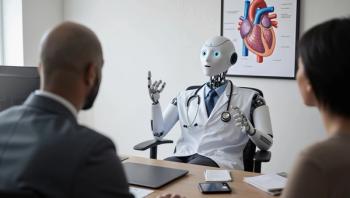
AI enhances health care but cannot replace the essential human touch and empathy that doctors provide in patient care and support.
Since the beginning of recorded medical history, physicians have been reluctant to embrace new ideas, technologies, and approaches to managing medical conditions. We have been creatures of our comfort zones. Even if the array of technologies offered brilliant solutions, it would be difficult for them to
At present, patients don't trust a robot or an intelligent algorithm with life-altering advice; maybe not even with a decision to take a painkiller. We don't trust machines/robots in tasks, even when they are better than humans, such as taking blood samples.
We need doctors to hold patients' hands while explaining a life-changing diagnosis, guide them through therapy, and provide overall support. Currently, an algorithm cannot replace that.
Artificial intelligence-based solutions are improving healthcare. We saw this coming over the past years, as easy-to-use programs such as
The medical community should not be swayed by fear-mongering surrounding AI. Despite the wide-scale automation and digitalization, humans will always be needed for specific tasks. Studies suggest that the use of robots and AI could lead to expanded employment opportunities and increased wages for healthcare workers. However, there is a growing concern about the impact of technology, from artificial intelligence potentially replacing
According to a quote that has now become a classic, "AI will be bigger than all other tech revolutions, and robots are likely to replace 50 percent of all jobs in the next decade," venture capitalist Kai-Fu Lee
Silicon Valley investor Vinod Khosla
Artificial intelligence-based solutions may eliminate the need for human labor. They will replace human resources in medical jobs that people dislike, such as mundane
Healthcare will likely require human involvement in the future.
AI will be embraced in most healthcare environments in 10-15 years. We already see good examples, such as the sepsis prediction algorithm that has cut sepsis mortality rates
AI will transform what it means to be a doctor; some tasks may disappear, while others will be added to the work routine. However, there will never be a situation where automation, whether in the form of a robot or an algorithm, will replace a doctor.
Even if the array of technologies offered brilliant solutions, it would be difficult for them to
At present, most patients would not trust a robot or an intelligent algorithm with a life-altering decision—maybe not even with a decision to take a painkiller or not. We don't trust machines, even in tasks where they have performed better than humans—such as taking
Setting up a diagnosis and treating a patient are not linear processes. It requires creativity and problem-solving skills that algorithms and robots cannot replicate.
Patients and their lifestyles vary to the degree that people differ. Diseases may share similar features, but no case is identical; everyone requires the attention of human physicians. Until the emergence of complex, digital solutions, doctors will need to interpret the data from simple medical devices and translate that information into medical decisions.
Sophisticated digital health solutions will require medical expertise, whether it involves robotics or AI. The human brain is so complex that it can store a vast amount of knowledge and data, making it probably not worth developing an AI to take over this job, as it does it so well. We should consider surrendering those data-based tasks and leaving the complex analysis/decision-making to the physician.
Physicians, nurses, and other medical staff members have many cumbersome, monotonous, and repetitive tasks to complete daily. A
However, there are responsibilities and duties that technologies cannot perform. While AI can sift through millions of pages of documents in seconds, it will never be able to perform the Heimlich maneuver, circumcise a patient, or counsel a dying patient. There will always be tasks where humans are faster, more reliable, cheaper, and more empathetic than technology.
It has never been a case of technology versus humans, as technological innovations always serve the purpose of helping patients. Collaboration between humans and technology is the
A non-medical example is from the game of chess. Human chess players threw in the towel following Garry Kasparov's defeat against a supercomputer. However, the opposite effect has occurred. Today,
AI has demonstrably enhanced chess by creating a more competitive, popular, and effective environment. AI has transformative potential in healthcare, where its adoption promises similar advancements.
Imagine what health care could be capable of if humans' creativity and problem-solving skills were combined with AI's infinite computing power and cognitive resources. Physicians must stop fearing AI and step up and embrace it.
The human touch is an integral part of the practice of medicine. It is a fundamental part of the patient-doctor relationship, where patients feel they are cared for by a human being. Patients want to feel that there is someone who not only understands their problem and offers a solution but can also easily feel their pain, fear, and anxiety. The human touch and empathy significantly enhance the healing process. The key takeaway is that patients tend to feel better when they encounter an empathetic medical professional.