

A new study suggests that practices wanting to let go of their paper-based ways should give local independent practice associations (IPAs), which are staffed by HIT-savvy medical pros, a chance to help.
A new study suggests that practices wanting to let go of their paper-based ways should give local independent practice associations (IPAs), which are staffed by HIT-savvy medical pros, a chance to help.
A recent physician survey shows that iPads, iPhones, and Android smartphones are the most popular devices among doctors. What’s more, 30 percent of physicians use a media tablet device, compared with just five percent of U.S. consumers.
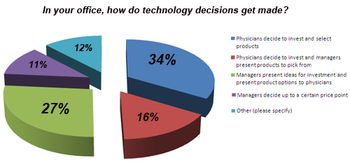
Who makes the technology purchasing decisions at your practice? Chances are it isn’t the physicians who actually use the technology - unless you’re part of a small, independent practice.
If your practice hasn’t started (or finished) testing for HIPAA Version 5010 of the electronic data transactions standard, to go into effect Jan. 1, 2012, you’re in good company. But why are so many practices and their partners behind schedule?
A newly released HIMSS survey, commissioned by McKesson, reveals that a large number of healthcare organizations, through the combined use of EHRs and other assessment tools, are not achieving their goal of “clinical transformation.”
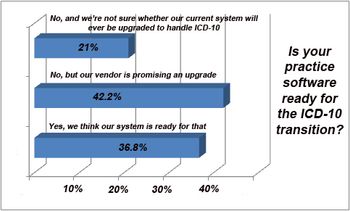
In a little more than two years your practice will have to start seven-digit, alphanumeric ICD-10 codes. Even sooner, you’ll have to get acquainted with 5010.

The transition to ICD-10 is a big one, so training your staff to understand and use the codes will take some time. In this podcast, Rhonda Buckholtz, vice president of ICD-10 training and education for the American Academy of Professional Coders (AAPC), offers some insight into this transition.
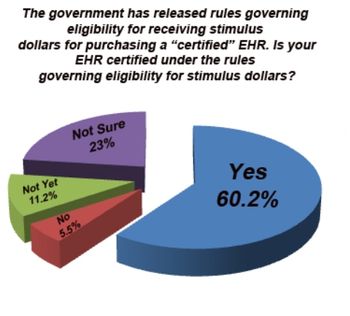
Getting an EHR to achieve certification is not always an easy feat for practices that had EHRs pre-meaningful-use, judging by the results of our 2011 Physicians Practice Technology Survey.
A plan proposed by Arizona state officials would impose a $50 fee to childless Medicaid recipients who smoke and/or are obese. How would such a rule impact physician practices?
As the government preps for a heavy summer reading schedule that no doubt includes pages of criticism to the 429-page ACO proposal, the question remains: Will all the extra shared-savings sweetening get healthcare organizations sweet on shared savings?
The feds are cracking down on (even accidental) violations of data security rules. Here's how to avoid serious financial and administrative penalties.
When personal computing devices are used in a professional capacity - namely for the access and transmission of patient data - it may be necessary for a practice to set guidelines for use.
With a slower economy, rising costs, and the increasing use of social networking sites, are medical associations still worth their dues?
Those who bought an EHR before the government started paying doctors to do so are wondering what they should do now. Here's how to judge whether your old system will meet the requirements to collect the stimulus dollars, or if you'd be better off starting anew.
New research indicates that video chatting developing into a medium where physicians and patients can instantly interact. But like most technology, there are issues that come with innovation.
If you’re a physician or practice manager and you’re not so sure whether this whole ACO “sharing savings” thing will work, you’re in good company. In fact, you may be in the majority.
Social media isn't just a tool for doctors to share health information. It's also a tool to establish your practice as a credible source for health-related information.
We’re sure there are at least a few physicians you know (maybe at your practice?) who are like old dogs when it comes to documentations. But would those physicians and staff most unwilling to learn new tricks actually quit if forced to change?
There are so many mobile apps patients can use to improve their health. Perhaps physicians should start recommending some.
Practices that want to join ACOs should start asking what hospitals are after.
For small practices, implementing an EHR and achieving meaningful use is a whole lot easier with a helping hand. Newly created regional extension centers are there to provide it. Here’s how to make the best of them.
We asked physicians, consultants, and staffers to share some of their best ideas on how to boost staff morale for $100 or less. Here are 20 of our favorites.
With the recent ACO proposal making waves across cyberspace and in doctor’s offices, there are a number of questions as to how “sharing” might transpire.
Anyone who thinks that physicians' slow adoption of EHRs makes them modern-day Luddites hasn't seen a doc with an iPad. Tablet computing does seem uniquely suited to healthcare, and physicians are warming quickly to the intuitive gizmos. But will tablets revolutionize medical practice - and yours?
For providers, HHS’ new Partnership for Patients initiative raises a few questions as to where the $1 billion will go.

That said, the proposal raises many questions for practices and their potential healthcare partners.
For practices, some crucial questions remain: Will they easily be able to join ACOs and get a piece of the savings? What will the impact on patient-care delivery models be?
AMA introduces a reference application for Apple gadgets, while physicians are called on to get creative in a medical apps competition.
Many physicians have discovered that blogging is a great way to build community with others in healthcare, share their opinions and successes, and vent.
One year since the Affordable Care Act was signed into law, its impact on Americans has turned into one of the most hotly debated and controversial subjects in physician circles.