



The Federal Anti-Kickback Statute is explained in this podcast by attorney Todd Rodriguez, who identifies common missteps and provides key compliance tips.
The Federal Anti-Kickback Statute is explained in this podcast by attorney Todd Rodriguez, who identifies common missteps and provides key compliance tips.
In this podcast, healthcare attorney Todd Rodriguez, defines the Physician Self-Referral Law, identifies common missteps, and provides key compliance tips.

Payers are mobilizing their reimbursement models to ensure that they are paying only for "quality" and "efficiency" in medicine.
Ezekiel Emanuel: confidence man
Paul Grundy, director of healthcare transformation with IBM, discusses meaningful connections through health IT and the patient-centered medical home care model.
Ever wondered what the future holds for your practice and your career? Here are four scenarios that might provide a better picture.
I believe that true healthcare reform will come about only when integrative and alternative medicine is embraced, not kept on the sidelines where it resides today.
By emphasizing a team-oriented approach to healthcare and using PAs, we increase access to care for our patients.
Could legislators really improve Medicare's fiscal picture? And, is it possible while also delivering choice of insurance coverage to millions of younger, working Americans?
As practices continue to deal with declining reimbursement, federal and commercial payers are exploring new payment models. Here's how to prepare and respond.
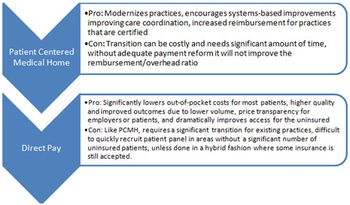
Feel like you can't do the fee-for-service practice model anymore? Here are several examples of new models in primary care that may the answer for you.
Which recent headline out of Washington, D.C. has you most nervous when it comes to the future of your medical practice?
Health reform is supposed to finally provide emphasis on healthcare quality when it comes to physician income, as a counterweight against patient volume. But are you ready for the changes? Plus: Are you earning what your peers make? The results of our annual Physician Compensation Survey are inside.

Because all medical practices are impacted by Medicare cuts ―as most payers tie their fee schedules to Medicare ― it is incumbent upon each of us to step up and make our voice heard.
Which best describes your attitude about the future of your medical practice?
New MGMA CEO and president Susan Turney discusses this year's event, her new role, and an ever-changing healthcare industry.
Sam Romeo with the Accreditation Association for Ambulatory Health Care gives some historical perspective on the patient-centered medical home and factors to consider in transitioning to this model.
A new report claims tort reform in Texas is ineffective because it does not cut healthcare spending. Experts say that’s an unfair assessment to make.
To simplify the healthcare dilemma as merely an offshoot of the drive for “profits” is certainly to understate the problem, though the words are not entirely off base.
We surveyed hundreds of American physicians on everything from their views on politics and public policy to their sense of professional satisfaction to how well they’re taking care of themselves physically and emotionally. You’re juggling so many demands on your time. How are you holding up?
Recently, as part of our virtual trade show, Physicians Practice Live!, I gathered some of healthcare's more perceptive thinkers for an in-depth talk about the future of private-practice medicine.
More physicians are opting for employment over the partnership track, hoping to avoid the headaches and hassles of owning a business. But is that that the right choice for you?
Here's my prediction: your practice will be audited in the next 24 months and asked to return overpayments.
In case you've been wondering how little influence physicians hold in Washington these days, consider how the triple-blow of health reform, deficit cutting, and ordinary Medicare spending adjustments will likely affect you.