


We have a marketplace that often values the time of lawyers more than the care provided by physicians. Something has to change.

We have a marketplace that often values the time of lawyers more than the care provided by physicians. Something has to change.
The focus of the 2012 presidential election now centers around the future of Medicaid and Medicare.
By the very nature of our healthcare industry there always have been - and always will be - differences in care.
Before ACOs are in full swing, HHS may need to make some tweaks to its current rules on physicians, relationships, and payments.
Amidst healthcare reform, ACOs, and watching primary care colleagues select employment over independence, I wonder whether solo practice is still for me.
Practice Notes blogger Wayne Lipton recently wrote that patients in concierge practices have more respect for their doctors.
How some private practice physicians are thriving despite decreasing reimbursement, increasing overhead, and hospital acquisition pressures.
If an ACO comes knocking on the door of your medical practice, here are some pointers to assess your potential new partners.
Many doctors in traditional practices feel like Rodney Dangerfield: They don't get no respect. But physicians in concierge practices are different.
Here are some issues to consider and some questions to ask before you become part of a large medical practice.
HealtheCareers Network recently released its analysis of the healthcare employment market based on industry job openings posted in the first quarter of 2012.

Strategic staffing: Get your pieces in the right places
Many PAs do very well in this ACO care delivery model because of their unique relationship with physicians, staff, and patients and coordination of care responsibilities.
Contemplating the membership model? Here are some of the key things to consider.
Payers are mobilizing their reimbursement models to ensure that they are paying only for "quality" and "efficiency" in medicine.

Paul Grundy, director of healthcare transformation with IBM, discusses meaningful connections through health IT and the patient-centered medical home care model.
Ever wondered what the future holds for your practice and your career? Here are four scenarios that might provide a better picture.

Converting the back of an ambulance to a modern office now allows me to see my patients at their home or work in my mobile office.
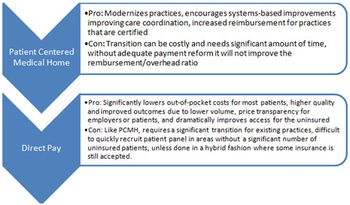
Feel like you can't do the fee-for-service practice model anymore? Here are several examples of new models in primary care that may the answer for you.
When developing a concierge approach for your medical practice, there are six things I recommend doing first.
Marc Halley, president and chief executive officer of The Halley Consulting Group, provides a guide to successful physician/hospital integration.
Sam Romeo with the Accreditation Association for Ambulatory Health Care gives some historical perspective on the patient-centered medical home and factors to consider in transitioning to this model.
To simplify the healthcare dilemma as merely an offshoot of the drive for “profits” is certainly to understate the problem, though the words are not entirely off base.
Recently, as part of our virtual trade show, Physicians Practice Live!, I gathered some of healthcare's more perceptive thinkers for an in-depth talk about the future of private-practice medicine.
More physicians are opting for employment over the partnership track, hoping to avoid the headaches and hassles of owning a business. But is that that the right choice for you?