







To avoid potential conflict, patients should be provided advance notice of your policy to avoid surprise and embarrassment.
To avoid potential conflict, patients should be provided advance notice of your policy to avoid surprise and embarrassment.

The healthcare ecosystem exhibits a clear void in efficient data and file sharing technology

Recommendations for every practice to consider.

Layers of specialty liability insurance are a vital part of your risk management and asset protection plans.

Revise contracts now with practical solutions for potential disaster that could occur in the future.

Plus: 6 ways to ensure quality in security compliance certifications

Takeaways from a recent False Claims Act Settlement and a CMS Final Rule.

Don’t fall victim to a tax reduction scam targeting physicians

In the eyes of the law, prescribing opioids for patients with chronic pain means upholding ethical standards of professional conduct, not following a checklist.

Privacy has always been as important as security. Biometrics add a new area for physicians and healthcare providers to watch.

Substandard care can lead to reduced payments for hospitals with excess readmissions.

The Department of Justice is taking action, so make sure you have an adequate compliance program in place.

A recent HIPAA fine and HHS’s healthcare app guidance underscore the importance of conducting risk analyses to protect personal health information.

The government is lowering its civil monetary penalties under the HITECH Act.

There are multiple reasons pass-through billing is illegal and fraudulent-and easy to catch.

Is your practice compliant with the Eliminating Kickbacks and Recovery Act of 2018 (EKRA)? If you don't know what EKRA is, you are not alone-and that is part of the problem.

If you are concerned that your security program is non-compliant, you should be-because you're worried about the wrong issue.
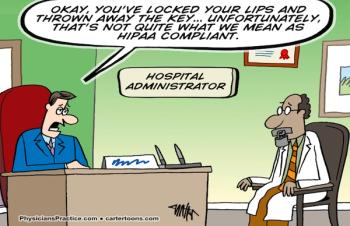
Unfortunately, it only really works for children.

Parsing out the various terms used in relation to a patient’s health record can be daunting. Here’s a primer to make the process less intimidating

An examination of asset protection issues from current news headlines highlights the defensive measures doctors and healthcare executives must consider.

Accepting payment via credit card is one way to improve patient collections. But medical practices must take precautions to ensure that their patients’ personal information remains protected.
Lax policies regarding medical records and ordering prescriptions and tests puts physicians-and their practices-at risk of DEA and HIPAA violations.

A trend to watch: Last year, two states made significant changes to laws related to personally identifiable information and protected health information.

More patients are recording their visits at the doctor’s office, sometimes without permission.

Although physicians may not be involved with the cybersecurity of medical devices, they are still obligated to comply with HIPAA and the HITECH Act.