Payers

Latest News


Manage your denials from insurance companies by tracking them in this worksheet. Track the denials according to the functional area to identify opportunities for improvement. By tracking and monitoring denials, you can fix the problem and prevent denials in the first place.

This simple work sheet will let you compare your payers' reimbursement for specific procedure with your costs for each procedure. If you're spending more to provide a service than you're making for it, then it's time to address the problem.

Use this easy calculator to find out which of your payers are worth your efforts. By comparing the percentage of revenue to the percentage of patient encounters for each of your payers, you can tell at a glance which plans are the poor performers.

Collections Letter 1

This is the first in a series of letters to use for patient collections.

Physician profiling is used by payers to steer their members to in-network physicians who, by their measures, are the most cost-efficient and provide the highest quality of care. Wonder if you’ve made the grade? Look yourself up in a provider directory: if you see a star or two beside your name, you’ve been profiled.

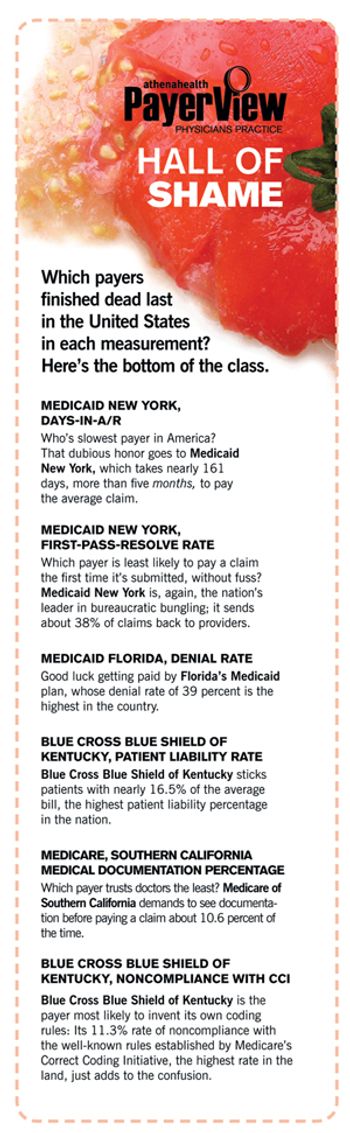
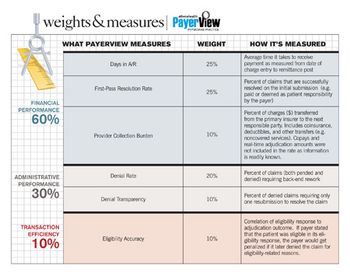
Our fifth edition of PayerView uses real claims data to examine and rank payers based on financial and administrative performance, as well as efficiency. Here’s to friendly competition that helps docs get paid.

Hba1c machines are fairly easy to use, they don’t take up a lot of staff or physician time, and allegedly they are decently reimbursed by most albeit not all payers. The machine is free, but the consumables are not. So after expenses, net reimbursement is about $5.

Knowledge is power in the payer game. Expert Lucien Roberts explains how to evaluate your payers and then use that information to negotiate better reimbursements.

Consultant Susanne Madden offers a step-by-step guide to handling payer take-backs and not getting bullied into writing a check without researching the situation.

Like it or not, given our weakened economy, medical practices no longer have the option of relying on self-referrals to guarantee that patients (and payers) will continue to line up at their doors.

I just got a refund request from a payer. It’s for close to $1,000 for a patient we saw from 2004 to 2007. The payer now says the patient wasn’t eligible then. We checked, and it turns out the patient actually was on a Medicaid managed care plan and was not with the payer we billed. Still, Medicaid won’t consider claims from 2004. I just do not know what my options are. Are there any regulations to prevent this?

I started an urgent care clinic. The insurance companies will not recognize us even though I have gone through the expense to make the facility equal to a small ER. How do I get acceptance from the insurance companies?