



While the debate over medical marijuana continues, one important issue often overlooked is the potential legal implications for physician prescribers.
While the debate over medical marijuana continues, one important issue often overlooked is the potential legal implications for physician prescribers.
Actual care delivered is only one of many reasons patients sue doctors. Sometimes, the behavior of one physician can affect others.
Now that compliance programs are mandatory, your practice needs to develop one. Here's how to get started.

With ICD-10, the Stage 2 rules of meaningful use, and other federal initiatives, CMS is moving full-steam ahead, according to administrator Marilyn Tavenner.
Laboratory reports are integral to a medical record and a patient's care. Therefore, this is one area that practices should look at carefully.

A little preparation will go a long way toward helping medical practices pass meaningful use audits.
With the Stage 2 rules of meaningful use looming, physicians are still struggling with the implementation process for Stage 1.
The U.S. EHR market is projected to reach $9.3 billion by 2015, the largest worldwide, thanks in part to meaningful use incentives, says a new Accenture study.
My advice to physicians given certain facts is simple: Practice defensive medicine that puts the full range of modern diagnostics at your patient's disposal.
Mobile devices bring great benefits to healthcare, but they also pose great risks. Here's how to mitigate those risks.
Physicians' reactions to EHR are the same as they were 20 years ago and yet, there may be no going back. But here are some steps to help.
An August FTC complaint against a medical laboratory indicates that medical practices could soon face more angst when HIPAA breaches occur.
Thirty seven states have now passed some version of medical malpractice apology laws. Here's what physicians need to keep in mind.
In light of increased federal surveillance, physicians must examine their controlled substance prescribing protocols.
Whether a physician is liable for an overpayment is not determined solely by whether such action is attributable to that physician.
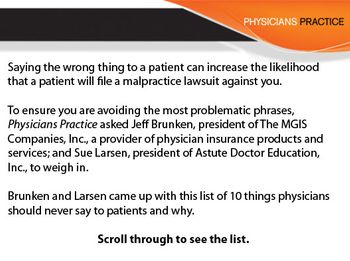
Poor physician communication makes it more likely a patient will file a malpractice lawsuit against you. Here are 10 things to never say to patients.
Measures to protect privacy sound good in theory, but unnecessary protections raise the cost and lower the efficiency of legitimate medical record sharing
A recent interaction involving a patient's mother makes me wonder why we can't dismiss family members and if there's a lawsuit on my horizon.
A recent report from HHS warns physicians about improper use of their EHRs, especially the copy-paste function.
EHR is a burden, and as such, there should be evidence of effectiveness before it is imposed upon physicians and medical practices.
No matter how cleverly structured, schemes to circumvent Stark Law are risky for physicians, and the consequences of failing to comply can be devastating.
Noteworthy items from Physicians Practice.
Medical practices face increasing difficulty collecting from payers, but off-loading the burden to patients is a big mistake.
With implementation of the health law now in full swing, many physicians are wondering how it will affect malpractice costs and claims.
President Obama discussed the Affordable Care Act briefly during the State of the Union address. What more should he have said?