
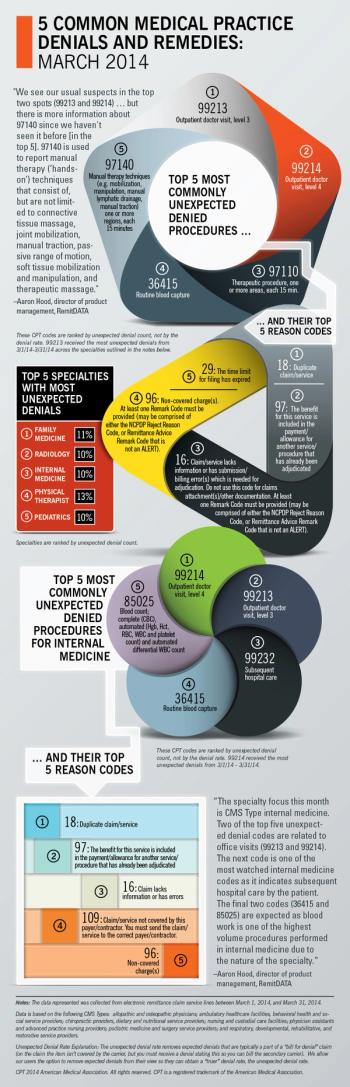
RemitDATA's director of product management, Aaron Hood, explores the most common unexpected denials at practices nationwide, with a focus on internal medicine.
RemitDATA's director of product management, Aaron Hood, explores the most common unexpected denials at practices nationwide, with a focus on internal medicine.

Whether you have one physician or 17,000 to prepare for the ICD-10 transition, here's how to get them invested in implementing the new coding system.

Why CMS should do away with hospital-led ACOs, and instead, focus on physician-led ACOs.

With physicians and practices in limbo on the ICD-10 transition, CMS reaffirmed its commitment to the code set and says a new deadline will be announced shortly.

Having at least another 18 months until ICD-10 becomes a reality can be a good thing for your medical practice. Here are four things to start doing today.
Despite how you feel about the ICD-10 delay, make it work for you, not against you. Here are five planning strategies to consider.
Payers are using deceptive methods to get medical practices to accept low rates and new plans. Don't fall into the trap.
New rules will now require Medicare enrollees who are classified as “high risk,” to subject themselves to fingerprint-based background checks.
Use this sample patient credit card authorization policy to ensure your medical practice is able to collect what it is owed.

In this podcast, consultant Susanne Madden shares how medical practices can store patient credit card numbers securely and effectively.
Here are four assessment areas your practice can use to develop training for the ICD-10 medical coding system transition.
If the government can make it appear that doctors are getting rich from Medicare payments, it will be easy to garner support to cut physician payments in the future.
Patient credits are part of the bigger picture of managing a healthy practice. Manage them right, and everyone walks away happy.
A medical practice director who worked hard to prepare for ICD-10 implementation says the delay comes at a heavy cost.
Whether they think it is good or bad news, savvy physicians will use the extra time to prepare their practices for the ICD-10 coding transition wisely.
Workers' compensation carriers are banking on the fact that at some point medical practices will give up and walk away.

Whether your medical practice was ready to implement ICD-10 in October 2014 or not, here's what you need to do to get ready for the transition in 2015.
Physicians and medical practice staff must be able to differentiate between preventative and diagnostic services in order to avoid a loss in revenue.
The ICD-10 implementation delay was cause for celebration for many medical practices, but it angered and frustrated many in the healthcare industry.

Robert Tennant, senior policy adviser of government affairs for the Medical Group Management Association, discusses the ICD-10 delay.
Congress decided that physicians need one more year to prepare for ICD-10. Here's what it means for your medical practice and the healthcare industry overall.
Sometimes insurance companies get between patients and their physicians; especially this time of year when health plans make changes.
Do you cultivate positive, working relationships with your key departments or vendors? If not, changing your approach might yield amazing results.
The 90-day “payment grace period” for exchange insured patients puts physicians at risk for 60 days if patients don't pay their premiums.
Payers know that correctly writing down every patient encounter is difficult for physicians, if not impossible. Therefore, exploiting this is easy for them.