






Management & Administration
Latest News
Advertisement
Latest Videos









Shorts

1:31
MGMA's next 100 years start with listening
4 days ago
by
Akash Madiah

1:30
The Medicare inflation crisis
4 days ago
by
Anders Gilberg
1:03
AI in health care: The new wild west?
a month ago
by
Anders Gilberg
1:11
How a same-day pay cut could turn one visit into two
a month ago
by
Anders Gilberg

0:49
When patients have to become insurance experts
a month ago
by
Rebecca Schoon, Ph.D.

1:10
Why clinical AI might actually raise health care costs
a month ago
by
Caroline Pearson

1:53
What an MSO has to deliver to be worth it
a month ago
by
Wayne Winegarden, Ph.D.

1:01
Being a primary care physician is a great honor
2 months ago
by
Lawrence P. Casalino, M.D., Ph.D., M.P.H.
0:48
AI is about to show up in malpractice claims
2 months ago
by
Robert E. White, Jr.

1:12
Why practices don't trust the technology they just bought
2 months ago
by
Aaron Ledbetter, M.P.P., M.H.S.A.
Podcasts











Advertisement
More News

Former Integrated Medical Services CEO Monique Delgado explained how practice leaders can build performance-based physician pay with physicians at the table and why the work starts with the practice's own finances.

From payer contract homework to a 15-minute morning huddle, these are the moves practice administrators can make after four days of sessions and interviews at MGMA's centennial meeting.

A family physician and practice owner shares the structure, roles and timing that make her team's 15-minute morning huddle work, and how to adapt it to a practice of any size.

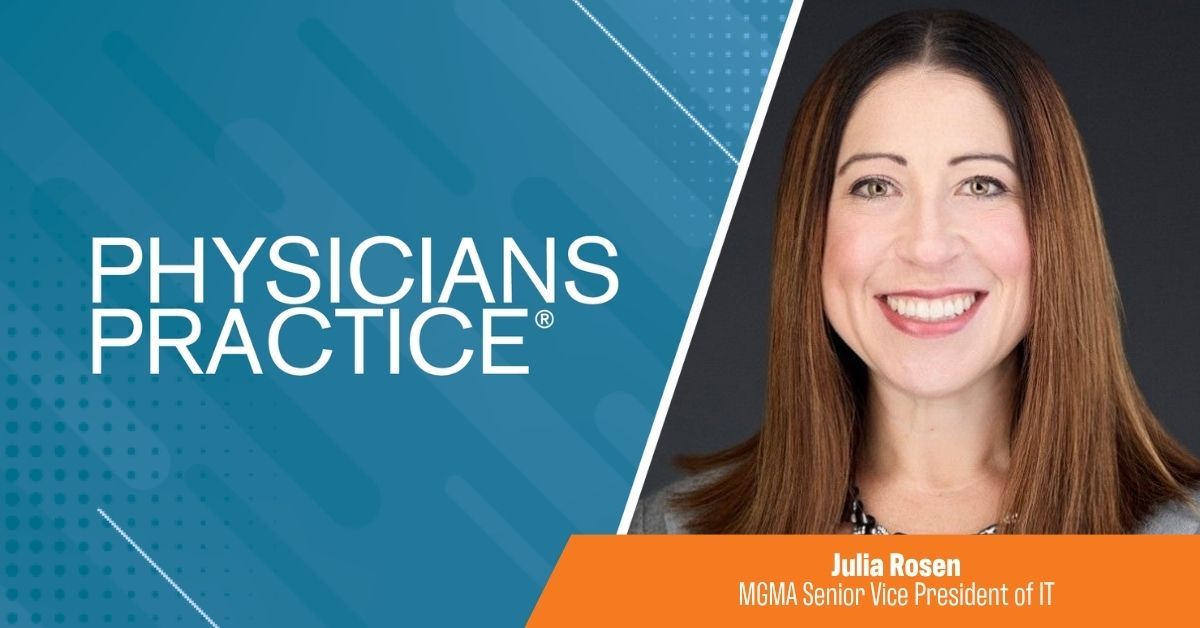
MGMA's senior vice president of IT explains how administrators can choose technology, win staff buy-in and keep up with cybersecurity updates.

A Utah program allows Nolla Health's AI to prescribe acne treatment within physician-approved limits. Physician review scales back as more patients enroll.

Madison Hynes of MGMA explained what practice leaders should watch as electronic prior authorization and Medicaid work requirements arrive Jan. 1.

Don't 'throw everything at it' before examining reasons why patients don't arrive for treatments.

Health care attorney Tatiana Melnik, J.D., says practices adopting artificial intelligence tools should reread their vendor contracts, train staff every week and plan for patients who decline an AI scribe.

Medicaid work requirements, new remote monitoring rules and an electronic prior authorization deadline all land Jan. 1, and that's only part of what MGMA told practice leaders to watch.

Six national physician organizations warned that claims of AI superiority undermine patient trust, putting new attention on how practices set rules for AI use by clinicians and staff.

Hold times, delayed approvals and denials on authorized care dominated member feedback to MGMA's government affairs team.

Seema Verma describes state of AI deployment in medical practices for MGMA.

Akash Madiah said work is underway on the local engagement, education and digital improvements members requested, and MGMA recognized its 2026 honorees, including Lifetime Achievement recipient Tracy Bird.

A roadmap for practice profitability as expenses climb and revenue stays flat
Published: | Updated:
A longtime MGMA analyst outlines the first area of focus to become a top performer.

MGMA's government affairs team walked through the fee schedule, MIPS, value-based care, Medicaid, Medicare Advantage and the year-end spending fight.

Most practices have no protocol for the hour after a medical error, and Anthony Orsini, D.O., says that gap is what turns a minor mistake into a lost patient and sometimes a claim.

A former MedPAC commissioner argues that whether clinicians feel like professionals or like interchangeable parts decides the quality of everything a measurement program cannot see.

Flat malpractice premiums are masking a severity trend running well ahead of inflation, and the cushion holding rates down is running out.

The rules on who can own a hospital are shaping consolidation in local markets, and the evidence behind them hasn't held up.

Vaccine inventory is getting more expensive, the counseling time around it is not reimbursed, and the practices that stop stocking lose more than the margin.

The insurer pledge on prior authorization carried no enforcement. The federal rule arriving Jan. 1, 2027 does, and it lands on payers, on EHR vendors and, through a new attestation measure, on practices themselves.

Denials that surface a week late, a hybrid revenue cycle split across internal staff and outside vendors, and payer contracts multiplying faster than anyone can track them. Veradigm's Aaron Ledbetter breaks down which of those an administrator can fix with better tooling and which still need payer reform.

Jay Bregman of Andel explains how employers are carving high-cost drugs out of the pharmacy benefit, and what happens to a patient's price when the contribution stops.

Every practice has one person who is the only one who knows how to do a handful of things. Here are eight of them, and what breaks the week that person is out.

Shawntea Gordon of Atlas & Perpetua Healthcare Consulting says a cost cut made without benchmarking data is a guess, and the wrong guess costs more than it saves.
Advertisement
Advertisement
Trending on Physicians Practice
1
State AI insurance laws give practices new grounds to fight denials and downcodes
2
8 ways to pull your practice leaders back from burnout
3
Protect, grow or cover differently — getting ahead of physician vacancies in rural settings
4
Survey: Pennsylvania candidates back ending NP collaboration agreements
5